/f/102932/1240x697/8d44f53ad7/audible-stories-that-speak-to-you-ooh-2.png)
Audible: Making Time Well Spent
Marketer Mags Zielinska-Banks and Wavemaker’s Rachel D’Cunha on turning a global brand platform into a locally relevant media idea – from summer travel to the daily commute
05 October 2026
What if the time between things wasn’t really time to be filled, but time to be transformed?
That is the idea behind Audible’s latest global brand campaign, Stories that Speak to You, which makes the case for listening as something more than entertainment on demand. A story can change the way a journey feels, make a daily routine more absorbing, or simply turn a few otherwise forgettable minutes into time well spent.
With WPP Media’s Wavemaker, the campaign runs across 12 markets and 11 languages. Despite its global reach, Audible's ambition is intensely personal: to make an intimate experience – one person, one story, one set of headphones – feel relevant to millions of people in very different moments.
That tension between scale and intimacy has shaped the media thinking. In the UK, Wavemaker built the campaign around the rhythms of real life, from the disruption and possibility of summer travel to the return to routine in September. The result is media designed not simply to carry the campaign, but to become part of the story itself.
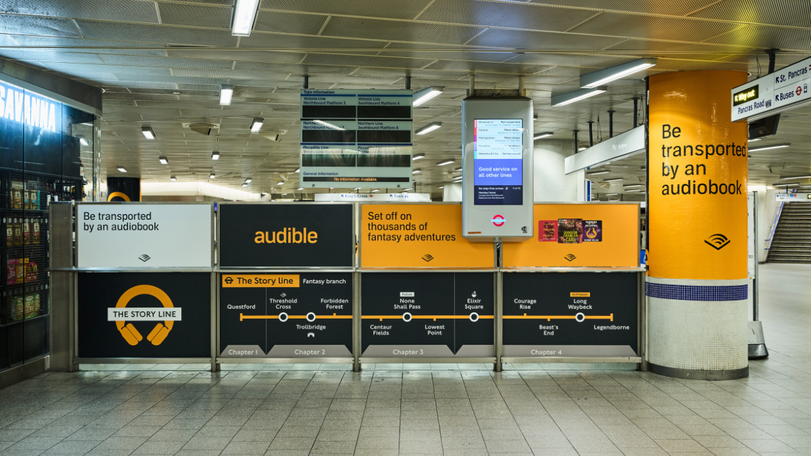
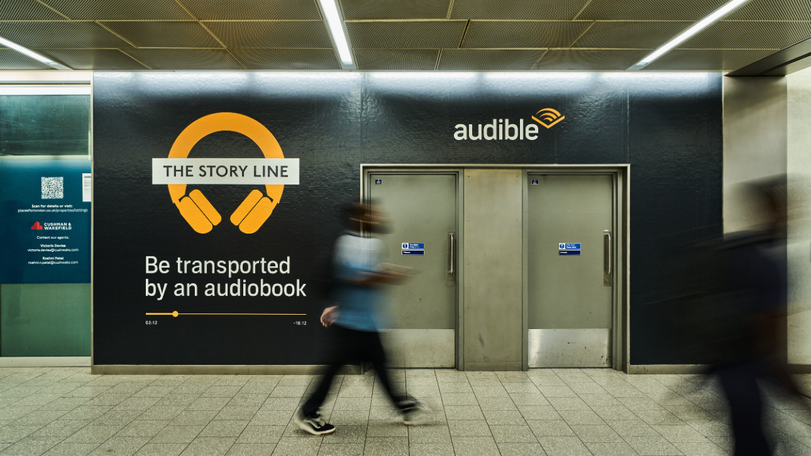
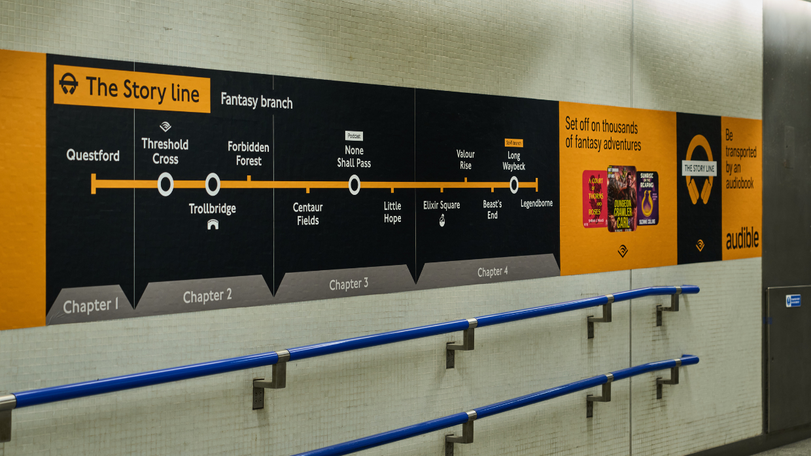
The most literal example is The Story Line, a fictional Tube line created at King’s Cross St Pancras, with stations inspired by Audible titles and genres. Elsewhere, the same thinking has been adapted to local habits and environments, from branded Story Trams in Germany to Maxi Metro Torino posters in Italy.
Creative Salon spoke to Mags Zielinska-Banks, media director – Europe at Audible, and Rachel D’Cunha at Wavemaker UK, a WPP Media brand, about turning a global proposition into something locally resonant – and finding the moments when a journey, a commute or a familiar routine can become story time.
CS: Stories that Speak to You presents listening as time that enriches you: whether that means escaping, improving yourself or transforming an everyday routine. What customer insight inspired that positioning?
Mags Zielinska-Banks: We are living in an era saturated with short-form, passive content that's designed to fill time rather than enrich it. And what we're seeing from our listeners is a real hunger for the opposite: something that rewards their attention and leaves them feeling like that time was genuinely well spent. Some listeners seek to enhance routine moments — a commute, a run — by weaving a great story into the fabric of their day. Others are seeking that deeper escape: losing themselves in an immersive, cinematic production where the performances, the sound design, the storytelling all pull you in completely. Stories that Speak to You is centred on the insights that customers are seeking fulfilling time spent, and that audio storytelling can actively enrich listeners’ lives.
CS: The campaign follows Audible’s first global brand campaign from 2024. What has the brand learned since then, and how does this new chapter move Audible’s story forward?
MZ-B: Our first global campaign, There's More to Imagine When You Listen, was a landmark moment for us — it united our brand voice across markets and invited listeners to explore the limitless worlds that audio storytelling unlocks. We’ve also learnt that our brand connects most deeply when we centre the listener's emotional experience, not just our content catalogue. This chapter builds on that foundation. Where the first campaign invited people to imagine, this one is about what happens after — how a story can genuinely shift the way you feel, think, or move through your day. On a UK level, we also learnt that local voices resonate for our brand, so we built out the local elements of the plan to include bespoke placements and advocacy partnerships.
CS: This is an international platform, spanning 12 markets and 11 languages. How did you create one emotionally consistent idea while leaving room for local cultures and listening habits?
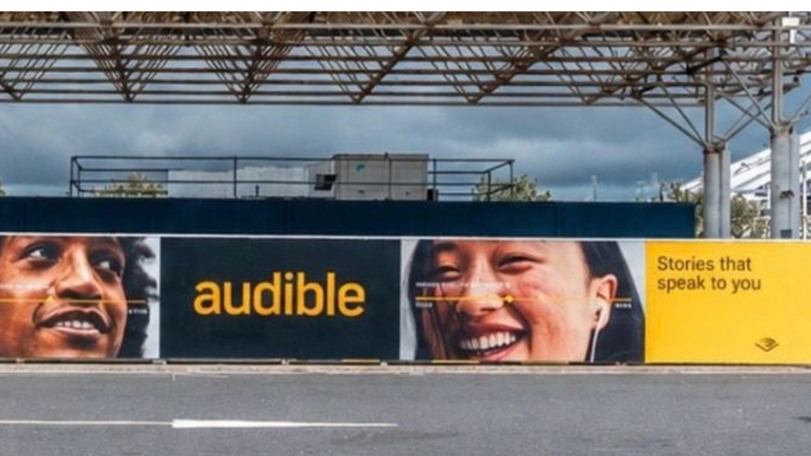
MZ-B: The emotional core — wanting your time to feel meaningful, and finding that in a story — is something that resonates regardless of where you live or what language you speak. That gave us a strong universal foundation to build from. We then worked to bring it to life locally. The creative idea and visual identity are consistent across markets, but the expression adapts to where and how people listen. We're meeting audiences in the places and moments that matter to them, whether that's a major transit hub, a sporting event, or a local entertainment tentpole. In the UK, for example, we made the messaging contextually relevant to local audiences and to each placement — crafting location-specific lines for our Kings Cross station domination with TfL and our LeShuttle activation, so the campaign spoke directly to people in those moments. We also partnered with key publications like Hearst and Stylist, using their editorial voices to bring local authenticity and tonal resonance to the work. The goal is for the campaign to feel native in every market, not imported.
1/2
2/2


CS: Audible is investing across original series, full-cast productions, investigative journalism and reimagined classics, alongside features such as immersion reading and AI-powered discovery. How is that broader innovation shaping the brand promise?
MZ-B: Our brand promise has always been rooted in the power of storytelling, but the way we deliver on that promise has continued to evolve. We're investing in content that raises the bar for what audio entertainment can be — from groundbreaking original series and full-cast productions featuring top-tier talent, to investigative journalism and reimagined classics. At the same time, we're innovating on the product side with features like immersion reading and AI-powered search and discovery, which make it easier than ever for listeners to find stories that truly resonate with them. Together, these investments are shaping a brand promise that goes beyond a library of titles. Audible is a destination for captivating, immersive storytelling experiences — one where the quality of the content, the craft of the production, and the intelligence of the service all work together to ensure that every listener finds stories that genuinely speak to them.
CS: How did you translate Audible’s global creative platform into a UK media strategy that felt locally relevant without losing the scale and consistency of the global idea?
Rachel D’Cunha: The insight around ‘time well spent’ is universally true, but from a UK market perspective we were launching at a very specific moment in the year, with implications for how time generally is spent; August - the height of the summer holiday season.
This is a time of year advertisers might normally shun for a big brand relaunch – people’s everyday routines are disrupted, their habitual behaviours are on hold, and there’s a drop in certain traditional media consumption.
But we recognised this offered a unique opportunity. Behavioural science studies show that when usual routines are disrupted, consumers are more receptive to discovery; in fact they are on average +75 per cent more likely to try new things and experiment with new brands. We also know that summer behaviours bring more demand for on-the-go entertainment; as people travel and spend more time out and about, online shopping goes down, but there’s more streaming, more downloads, more desire for quality, curated content to accompany their adventures.
In August, our opportunity was to match that summer energy and meet that consumer demand. We used media to create visibility at scale, showing our audience how Audible enriches their summer, priming them for when life returns to normal.
Then as the campaign moved into September, when two out of three people describe themselves as ‘ready to reset’, our role for and use of media shifted. We needed to transition with the audience back into the usual patterns of work and life, inspiring them with enriching content that fits into their everyday routines.
So we had one big campaign, but two media approaches. Both true to the global idea, but designed to match the mindsets and behaviours of our local UK audience over this distinct time of year.
CS: From WPP Media’s perspective, what was the most exciting challenge Audible set you with this campaign?
RD'C: One of the best things about working on Audible is the genuine appetite to do big, bold unmissable media. The stuff that gets noticed, and ignites mass excitement for the world-class content Audible offers.
At the same time, the experience of using Audible is often intimate, curated and highly personal.
In Stories That Speak To You – the ‘you’ is both the collective, millions of consumers across the UK who can enjoy time well spent with Audible, and the individual ‘you’, who may choose to enrich your commute, early morning run or Tuesday evening wind down.
We considered this dual approach when designing of the plan, to reflect both these audience truths.
The plan carefully blends high impact, attention-grabbing activity, with community-led, participatory touchpoints, and ritual-driven media that taps into the moments that reflect individual listening occasions.
The result was a media plan that, we believe, delivered the impact the brand launch warranted, with the down-to-earth resonance needed to drive consideration as well as awareness of the brand.
CS: The plan moves between travel, entertainment, commuting, self-improvement and evening wind-down moments. How did you identify the moments in which media could make Audible most relevant?
RD'C: The use cases for audio storytelling in everyday life is generally wide ranging, hence why Stories that Speak to You works so well as a global positioning.
From a media perspective, we’re big fans of the Ehrenberg Bass and Jenni Romaniuk school of mental availability and category entry points.
The ideal scenario is to build as many networks of associations as possible between your brand, and the where, when, why and how you can meet the needs of your audience.
However in reality, you have to prioritise, and we spent a lot of time digging deep to identify the biggest growth opportunities, and mapping that back to the distinct consumer mindset and behaviours at this time of year.
Whilst demonstrating breadth was important, through this process we knew where we wanted disproportionate impact, and set out to make Audible unmissable in these environments.
Firstly, in ‘gloriously out of home’ travel moments over the summer period, and secondly in ‘back to routine rhythms’ as people transitioned into autumn.
In August this saw us prioritise activations at major airports (download before you fly), at roadside services (keep the kids entertained on the looooong car journey to your staycation) and Le Shuttle (enrich your under the sea jaunt between the UK and France).
And in September, we embraced cosy moments at home and owned the evening wind-down, a hugely popular use-case for Audible, as well went big on the commute.
1/2
2/2


CS: A clever way the campaign was brought to life in travel was through the King’s Cross Underground takeover, The Story Line. Was this designed as a bespoke London activation, or is there potential to take the same thinking into other markets?
RD'C: The Story Line was a proudly and iconically London idea, dreamed, built and executed by our brilliant team here in the UK. But the beauty of a global campaign centred on a universal human truth, is that the kernel of an idea like the Story Line can travel across markets and be expressed in different ways with local flair.
For example in Germany, another core marketplace for Audible, we created bespoke, Audible branded Story Trams, with fully wrapped carriages that transported people through major conurbations. This created impact both for those using the tram network itself, and those seeing it from the outside, brightening up the urban landscapes of Berlin and Düsseldorf.
Through this approach, we showed audiences that travelling time can be story time, and with Audible, even the most mundane of moments can enrich you in whole new ways.
Share


