/f/102932/1240x697/fa745e15b6/karen-ehrlich-clinique.jpg)
CMO Spotlight
Counter Culture: Clinique x Crayola collab is colouring outside the lines
Karen Ehrlich, VP and general manager at The Estée Lauder Companies UK & Ireland, shares her brand path and talks about collaborating with Crayola
25 March 2026
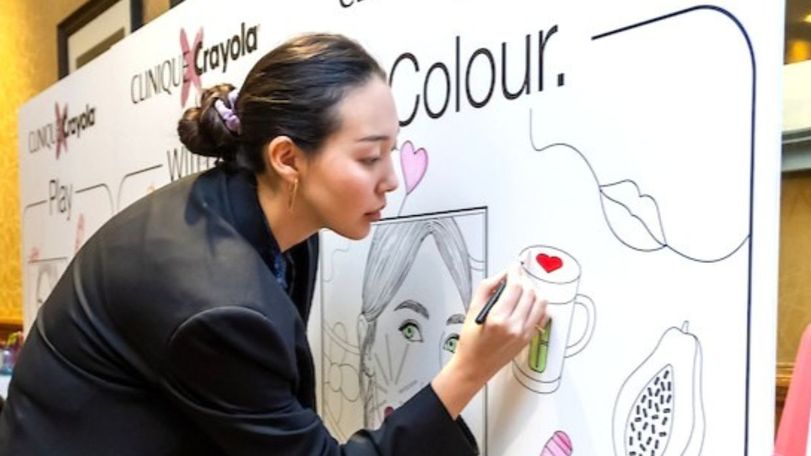
Walk up to a Clinique beauty counter right now and you might find a giant colouring wall alongside the skincare and makeup. You might be handed a crayon alongside a shade card. You might be invited not to get it perfect.
This is the Clinique x Crayola collaboration, and it’s no accident that it feels like something your inner child would love. Crayola’s iconic childhood crayons – around since 1903 – were the inspiration for Clinique’s original and now iconic Chubby Sticks, first launched in 1997.

It is, by design, counterculture. A deliberate pivot away from the perfected image of the beauty counter itself, and the relentless pursuit of Insta-perfect faces that has come to define so much of modern beauty marketing. In a landscape dominated by AI-filtered flawlessness, Clinique is colouring outside the lines.
Play with colour
The partnership, launched in February, centres on the relaunch of Clinique's iconic Chubby Stick line — fat, crayon-like lip and cheek colour sticks (think ‘Tickle Me Pink’, ‘Razzmatazz’ and ‘Mauvelous’) – that have been a staple in makeup bags for nearly three decades.
While the visual match is blindingly obvious, the strategic thinking behind it runs deeper. Ehrlich, who oversees Clinique UK as part of a portfolio of five Estée Lauder skincare brands including Lab Series, Dr.Jart+, Origins, and La Mer, identified a powerful current which drove the collaboration.
"What we see today in culture is that there's a lot of pressure. A lot of brands are driving this need to look beautiful, to look flawless, the rise of AI filters — it's pushing everyone to look their best. But with that comes a burden for the consumer."

In identifying that pressure point, Ehrlich saw Clinique’s angle.
"Consumers don't need more pressure in their lives,"she says. “And we also see this huge trend around wellbeing and creativity. Inspired by our 'play with colour' concept, we asked: how can we make consumers feel confident to try colour in a way that is not pressured? How can we take the playing and colouring they are already doing, and bring it into beauty?"
From shelf to self-care
Ehrlich had spotted something: amidst a growing need for stress relief and mindfulness, grown-ups are reaching for felt tips and colouring books as a form of escapism, relaxation, and creative release. And the numbers are beginning to reflect a mainstream impulse; the global colouring books for adults market, valued at $151m in 2024, is projected to reach $320m by 2030, growing at nearly 10 per cent annually.

At the same time, self-care has become one of society's defining preoccupations. A YouGov survey shows 24 per cent of Britons engage in self-care activities every day, with a further 44 per cent doing so at least once a week. Women are slightly more likely than men to prioritise it (85 per cent versus 78 per cent) and the activities they gravitate towards skew strongly towards the tactile and the sensory: relaxing baths, in-store retail therapy, time outdoors. With its invitation to play, the Clinique x Crayola colouring wall is a moment of low-stakes creative absorption that happens to take place next to a lipstick display.
Real, tactile, human moments
The marketing strategy is deliberately experiential. Rather than leading with a social media campaign and chasing reach metrics, Clinique and Crayola built the activation from the inside out — starting with real, tactile, human moments.
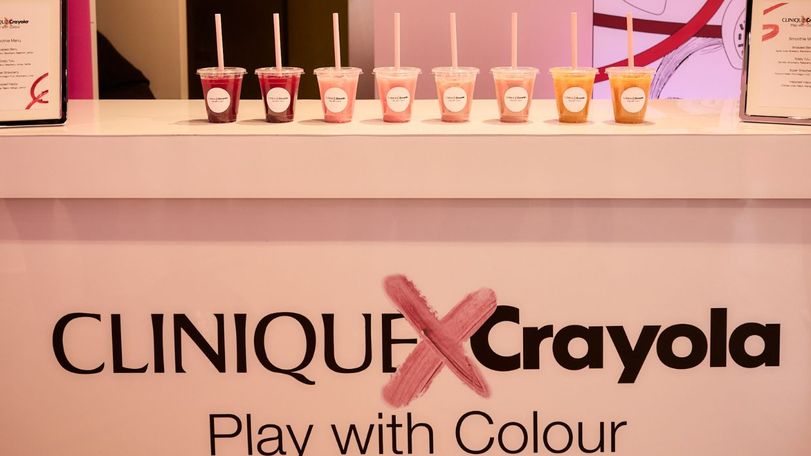
The partnership was unveiled at an influencer and creator event in London, designed to announce the new collection and allow attendees to experience the collaboration first-hand. Guests had the opportunity to interact with the new shades and explore the experiential elements of the partnership, including the life-sized colouring wall. A press kit — inspired by the Crayola sets many of them will remember from childhood — contains a colouring book, Crayola crayons colour-matched to the new Chubby shades, and the products themselves.
From March to May, retail activations will pop up in selected cities nationwide, where shoppers will be able to experience a version of the London activation in-store. The idea, Ehrlich explains, is that the brands she steers become their own best storytellers – not only through paid advertising, but through the consumers themselves.
1/2
2/2


"Once they engage and we are able to create something that is meaningful to them, not only can they try and buy the products, but they can also tell the story much better than we do. We can create word-of-mouth amplification," says Ehrlich.
The influencer strategy, delivered in partnership with Pangolin, is attuned to the concept of play rather than perfection: inviting creators to engage with the colouring wall experience, not just hold a product in front of a ring light. The core creative was developed in-house, with Clinique's internal studio working directly with Crayola's.
From São Paulo to Pernod Ricard to general management
Ehrlich’s path is, fittingly for someone now championing counterculture, eclectic. She began in her native Brazil, working for Johnson & Johnson baby and sun care brands. From there came a move to Pernod Ricard, where she built luxury spirits brands like Chivas Regal whisky — first locally, then with the global team in London.
"In luxury spirits, you’re building emotion," she says. "It's a category that is 99 per cent emotional and 1 per cent functional. You can rationalise that a whisky is 15 or 20 years old, but what consumers buy into is a lifestyle, a behaviour. It's much more challenging to build a brand when you just have the emotion, versus skincare when you have emotion plus functionality."
The experience of building brands from emotion, without the safety net of a compelling product benefit, sharpened her instinct for what actually drives human connection. It’s a skill she brought back to beauty, and then transferred into a move from marketing into general management.
"I really believe that the best general managers have a CMO background, and vice versa," she says. "Being in marketing allows me to understand the consumer, the culture, and behaviour really well. But moving to general management, I can go beyond that, and make sure I'm translating it to all the touchpoints – not just campaigns, but commercial execution, distribution strategy, everything — always with the consumer at the centre."
Brand DNA and the human truth
Ask Ehrlich to identify the common thread across five Estée Lauder brands, a career spanning two countries and multiple categories — and she returns to the same idea:
“It's a combination of understanding the consumer, the human truth, and the cultural context, but also the DNA of the brand. We're not trying to deviate from what the brand stands for. If we stay true to that, and also relevant — that's how we keep modernising the brand."
Last summer, Clinique became the official beauty partner of England Rugby World Champions the Red Roses. The sponsorship is an extension of its Game Face programme, a grassroots movement launched in 2022 to provide support for women’s or girls’ grassroots rugby clubs through funding, equipment and education after research showed that young women were dropping out of sport because they didn't feel confident in their own skin.
Given that Clinique's entire brand promise is built around helping women feel confident in their skin, the fit was clear. The brand partners with women's rugby clubs across England, and recently launched 'Game Face season three' focusing on the brand's search for four grassroots clubs to apply for sponsorship.
Among consumers aware of the partnership, 42 per cent report a greater willingness to consider Clinique. It is, Ehrlich suggests, a model for how heritage brands stay culturally relevant: not by chasing a fleeting moment, but by identifying where a brand’s deepest values intersect with what people actually need right now.
In a beauty industry grappling with what it means to be authentic rather than perfect, Ehrlich’s answer is a colouring wall, a box of crayons, and an invitation to play.
The world of marketing according to Karen Ehrlich
What excites you most about being a marketer?
It's constantly evolving — it's different every day, and that's what I love. With TikTok, and now with AI, it's getting even faster. This doesn't allow us to be in our comfort zone, and luckily, I'm not the type of person who loves to do the same thing over and over. I love to understand what's happening in culture, what consumers need, and how we can bring something that is powerful and makes our brands unique.
What frustrates you most?
When we think about creativity and effectiveness as separate things. You can look at a campaign and say it had amazing reach, amazing frequency — AI can automate that for the best results. But if you're not generating meaning and emotional connection, if the creative is not powerful enough to provoke consumers to think about the brand, to feel the brand, you're not going to achieve the shifts you need.
What makes a good agency partner?
Two things.
First, great strategists who really understand consumers and have their fingers on culture and trends — they are able to separate the noise from the signals that are relevant to that particular brand.
And then creative teams that are able to think about platforms, big platforms, rather than just touchpoints. The best experiences I've had were working in real partnership — when an agency has challenged and helped me to sharpen the brief, and then come back with fresh, disruptive approaches.
What is a career moment you are particularly proud of?
Definitely the move from marketing director to general manager. I was able to go beyond what marketing is responsible for and look at commercial, online, education — always putting the consumer at the heart of everything. I really think it's a big point of difference and creates strong outcomes, not only in marketing, but in the other areas too. And having the chance to work with five amazing brands — that really makes me proud.
What would be your advice when developing a strong creative brief?
It's about clarity. Start with understanding the human truth — what is the consumer telling you, what is the cultural context you're in? Then ask: how do you want consumers to think, feel, and act after they experience your product? And how can your brand do it in a way that no other brand can?
Is there a campaign you wish you'd made?
Two come to mind, and they both still inspire me.
The first is 'Fearless Girl' — the statue placed in front of the Charging Bull on Wall Street to talk about female leadership. [Part of State Street’s 2017 campaign to pressure companies to add more women to their boards.] What I loved was that the conversation it generated was enormous, because the human truth was so strong.
It's a great example for anyone who doesn't have a big budget — if you know what you're doing and you have a genuine point of difference, you don't always need a fancy TV campaign.
The other is 'Dirt Is Good' from Persil [originally created by JWT in 2005] — rooted in such a powerful truth, saying it's healthy and you should encourage your children to get outside or get creative, because that's the best sign that they're developing and happy. And it's a creative platform they've used over time; so much more than just one campaign idea.

Share


