
MSQ Asia: Building A Business Without The Baggage
As Chinese brands rewrite the rules of global marketing, MSQ is thriving in Asia without the constraints of a traditional network
23 November 2026
For decades, the world's biggest advertising groups have exported their business models to Asia. Global strategies, global agency structures, global ways of working, adapted where necessary to accommodate the peculiarities of local markets.
But what if they've got the direction of travel wrong?
Asia, rather than being the recipient of Western marketing wisdom, is increasingly becoming a place where new marketing models are being invented. And the agency groups best placed to benefit may not necessarily be the biggest, but those with the freedom to build something different.
It's a proposition that sits at the heart of MSQ's ambitions in Asia, where Susie Hunt (above right), chair of MSQ Asia, Po Kay Lee (above centre), who has recently joined from Stagwell’s Forsman & Bodenfors to lead the group's Southeast Asian business, and Angeline Kong (above left), who heads its Greater China operation, are attempting to build a business without many of the constraints that have traditionally defined international agency networks.
MSQ doesn't have the scale in Asia of the giant holding companies. But nor does it have their legacy structures to dismantle. There are fewer fiefdoms to defend, fewer reporting lines to negotiate and less pressure to organise people around individual agency brands rather than the problems clients need solving.
And building something fit for purpose in Asia also gives MSQ a ringside seat from which to understand the changes now heading west.
From BYD to Pop Mart, Chinese brands are exporting more than products. They are exporting ways of doing business, developed in one of the world's most competitive commercial environments.
For MSQ, this creates an opportunity that extends well beyond winning more clients in Asia. It can help Western businesses understand the competitive forces heading their way, while helping ambitious Chinese brands build recognition and relevance in unfamiliar markets.
Kong sees the opportunity for China to be "not as an outpost of a global network, but as a place where the future of marketing is being stress-tested, with lessons that flow back to London and New York."
And in markets where consumer behaviour, commerce and technology are evolving at extraordinary speed, MSQ's ability to build a different kind of agency business could prove a significant advantage.
A different type of value
For Po Kay Lee, one of the biggest misconceptions Western businesses have about Asia is that its marketing ecosystem is simply a faster, cheaper version of their own.
"It's not cheaper and faster. It is a different type of value."
Connected commerce, creators who collapse the distance between awareness and purchase, live streaming, fandoms and extraordinarily compressed innovation cycles are creating a marketing ecosystem that operates according to different rules.
And those rules are travelling.
Lee predicts connected commerce is "going to hit the US like a bullet train". The opportunity for global businesses is to understand what these innovations mean before their impact is felt more widely in Western markets.She's already seeing the direction of influence changing.
Driving along Robinson Road in Singapore, Lee was struck by the sight of a BYD showroom among the corporate offices. Rather than relying on the traditional car dealership model, the Chinese manufacturer had brought its brand into the heart of the business district, putting itself directly in front of prospective customers. "And then what happened, which I find even more phenomenal, is Audi then opened one, and then Porsche opened a cafe," Lee says.
"Western brands are following Asian brands."
It's a small example of a much bigger shift. Asia is no longer simply a market in which global brands compete. Increasingly, it's a place where new ways of building brands, engaging consumers and conducting commerce are being developed.
Susie Hunt sees a related problem: the persistent assumption that success in Asia begins with a global marketing model which can then be adapted for local markets. Too often, she argues, a carefully constructed global proposition reaches China or Indonesia and simply fails to resonate. Her advice is blunt: "Don't work from a start point of adaptation."
Instead, Hunt wants clients to use Asia to build different growth models in the first place. Bring the team to Shanghai or Singapore. Build something designed to win there. Then work out what the rest of the world might learn from it.
It's a reversal of the traditional international marketing model, which has generally assumed that the strategic thinking happens at global headquarters and the job of local markets is to make it relevant.
"MSQ is a home for entrepreneurs with unfinished business...This should be the most exciting company any of us has ever built"
Susie Hunt, chair of MSQ Asia
Angeline Kong, who leads MSQ's Greater China business, has a compelling explanation for why that approach is becoming increasingly inadequate. "Most global frameworks are built on an assumption that doesn't hold here: that discovery, consideration and purchase happen in different places, at different speeds, owned by different teams," she says.
"In China, the funnel has collapsed into a single scroll." A consumer might discover a product on Xiaohongshu in the morning, watch a Douyin livestream at lunchtime, buy it within the app and review it that evening. The Chinese concepts of zhongcao (planting grass, or seeding desire) and bacao (pulling the grass, or converting that desire into purchase) describe a consumer journey that is effectively continuous.
Different platforms require fundamentally different creative approaches, approval processes need to keep pace with cultural trends, and Chinese clients increasingly expect brand-building and sales to be measured together.
Kong points to Adidas turning an embarrassing AI translation error on a Chinese product page into a viral joke, then quickly producing customised t-shirts celebrating the mistake. Rather than trying to bury the error, the brand joined in. "The lesson isn't just that it was funny. It's that someone close to the market had the authority to say yes." That decision-making autonomy, rather than speed for speed's sake, is what interests her. "So the right starting point isn't 'how do we adapt our model for China?' It's 'what does winning look like on these platforms, with these consumers?'"
Think vertical, not horizontal
The distinction becomes even more important when people talk about Asia as though it were a single market.
Hunt has a neat way of describing the problem. "We think in verticals, not horizontals."
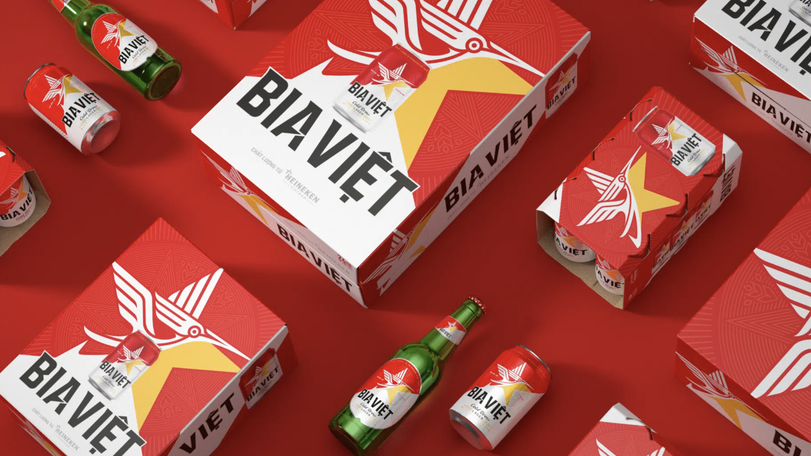
Asia is a geographic horizontal. The more interesting opportunities are the cultural verticals running through it. She points to Heineken creating Bia Viet specifically around Vietnamese culture.
1/2

2/2


Through Elmwood's work, the Bia Viet’s Lac bird became a powerful symbol of Vietnamese pride and progress, and Amstel’s iconic red and white circle and split formed the foundation of a brand identity system that empowers local markets to deliver local design execution, whilst ensuring the brand remained instantly recognisable across 180 markets.
According to Anna Bizon, who worked with Elmwood as marketing director of Heineken in Vietnam: "This collaboration and partnership have given Bia Viet an insight-driven design solution that checked all our boxes and more. I’m proud to say that we have something that really elevates and modernises Bia Viet across both our packaging and brand world."
But the principle can go much narrower. Asia has the population scale to turn what might elsewhere appear to be niche passions or communities into significant businesses.
Hunt imagines the opportunity among pregnant women who love pink fluffy socks and are fanatical pet owners. It's a gloriously un-corporate example, but the point is serious. Brands can find considerable commercial opportunities in culturally distinctive communities rather than relying solely on traditional demographic or geographic segments.
Lee agrees. After more than 16 years working in Asia, she remains wary of treating geography as a proxy for culture. "It's about cultures that exist, and even within those cultures there are micro cultures," she says.
For Kong, understanding those distinctions is central to working with domestic Chinese businesses, whose expectations of agencies can be markedly different from those of multinationals.
"The biggest difference is that domestic briefs start from the outcome, not the deliverable," she explains.
"A multinational brief often says, 'we need a campaign for Q3.' A Chinese brief is more likely to say, 'we need to win this category on this platform among this audience, and here is the data.'" While Western agencies may still spend weeks polishing a presentation, Chinese clients are more likely to want several rough ideas tested in market. "Decks matter less, and prototypes matter more."
And as Chinese brands increasingly look beyond their domestic market, new opportunities are emerging for agencies that understand both China and the rest of the world. Kong points to MSQ's work with Wuliangye, the Chinese baijiu brand, whose domestic positioning is rooted in the concept of Hemei, or harmony and beauty. Rather than translating the idea literally for international audiences, MSQ developed "Five Grains, The Art of Harmony", building on the five grains from which the spirit takes its name.
"That's the job in a nutshell: not translating the words but finding the part of a Chinese brand's truth that travels."
The power of the pivot
The speed at which Asian businesses operate is often presented as their defining characteristic. But for Hunt and Lee, the more interesting advantage is the freedom to change direction.
Hunt describes "the power of the pivot". If something isn't working in Cambodia, move. If Shanghai isn't responding, what about Chengdu? Rather than grinding through a marketing strategy because that's what the annual plan says, change it.
Kong describes a Chinese philosophy of xiaobu kuaipao, or "small steps, fast running": make many small bets, abandon the unsuccessful ones quickly and scale what works. "The best Chinese brands give the people closest to the platform data the authority to act," she says.
But she's clear-eyed about the downsides. Relentless iteration can exhaust teams, while an obsession with performance can come at the expense of longer-term brand equity.
"Many Chinese companies are now learning the value of long-term brand equity from the West. The best answer is probably a synthesis, which is exactly where we want to play."
For Hunt, the willingness to experiment also extends to involving consumers directly in the marketing process. She tells the story of a Chinese factory worker outside Chengdu who sorts gemstones for a living and livestreams herself doing it. She isn't a conventional influencer or gemstone dealer. She talks about the stones she likes, explains what she sees and has accumulated an audience interested in learning from her. "That's not about paying an influencer," Hunt says.
Instead of developing campaigns behind closed doors and testing at the end, brands can build co-creation loops much earlier. Consumers become participants rather than an audience peering through the glass.
Kong points to Xiaomi's early development of smartphones with input from its fan community, and to the way Chinese marketers now use comments on Xiaohongshu and Douyin as a live source of product insight. The distinction between product development and marketing is becoming increasingly blurred.
That requires agencies to rethink not just the services they offer, but how they organise themselves to deliver them.
Lee describes MSQ's way of working as unusually agile. Expertise is assembled around a client problem rather than being dictated by agency structures.
That approach is also shaping the range of capabilities MSQ is developing across Asia. Alongside its creative, social and commerce expertise, the group is looking to build further opportunities in communications, business-to-business marketing, and sport and entertainment. The ambition is to bring different disciplines together around client needs, rather than replicate the separate agency structures familiar from traditional networks. It is another way in which MSQ hopes to turn its relative lack of legacy infrastructure into a competitive advantage. For example, MSQ Sport + Entertainment has worked with Glanbia Performance Nutrition's Optimum Nutrition brand to activate its sponsorship of the McLaren Formula 1 Team, developing The Inside Advantage, a content and creator platform designed to challenge misinformation around sports nutrition. Bringing together creators, sports scientists and industry experts, the initiative builds on a partnership that has also been promoted across Southeast Asia, demonstrating the potential for global sporting properties to create opportunities for brands in the region.
The new Chinese good life
The changing relationship between consumers, technology and brands is also reshaping ideas about what constitutes a good life in China.
For previous generations, Kong explains, the good life tended to follow a predictable sequence: job, home, car, marriage, children. For many younger urban Chinese consumers, that sequence is no longer the defining ambition.
Instead, the idea of qingxu jiazhi, or emotional value, is increasingly important. People will spend money on products and experiences that deliver comfort, belonging, identity or joy. Pets are increasingly treated as family, while dazi culture sees people finding companions for particular activities rather than relying exclusively on traditional friendship groups.
"But I'd resist framing it as decline," Kong says. "It's a redefinition of what a good life is made of."
For marketers, the implications stretch from luxury and leisure to technology, travel and retail. Brands still relying on conventional images of family life or the aspiration to settle down risk missing some of the cultural energy shaping Chinese consumption. Luxury is already one place where those changing assumptions are visible.
Hunt argues that Western marketing has historically treated luxury as something consumers grow into: climb the ladder for long enough and eventually you earn the right to enter the rarefied world of expensive brands. "Rubbish," she says. In Asia, luxury is young.
She points to Louis Vuitton's ship-shaped destination, The Louis, in Shanghai, and the increasing importance of Asian cities to global luxury launches. Luxury brands are learning to create smaller entry points into their worlds while turning flagship retail into culture and entertainment.
For global luxury businesses, China is no longer simply a lucrative audience for an existing model. Younger Asian consumers are starting to change the model itself.
AI and the agency model
That willingness to discard inherited assumptions also runs through MSQ's approach to AI. As AI tools become more widely available, Lee believes access to them will cease to be a competitive advantage. "The difference will lie in how agencies organise themselves to use them.”
Hunt describes AI as a "cultural accelerator" for the Asian business, where employees are already experimenting with different tools. Rather than imposing a single way of working, MSQ is trying to give people the freedom to explore what works. That flexibility is particularly important in China, where the AI ecosystem differs substantially from those in Western markets.
Kong explains that MSQ Assist, the group's AI platform, uses DeepSeek for its Chinese operations, maintaining shared workflows while accommodating local technology and regulatory requirements. "Our colleagues in London and our team in Shanghai open the same tool in the morning, but the engine and the guardrails are designed for the market each of us works in."
For swimwear brand called Arena, Kong's team used AI to produce thousands of images and videos across more than 400 products, including virtual models and product scenes. The project took three and a half weeks rather than the roughly two months required for traditional production, at approximately 35 per cent lower cost, according to Kong.
"But the real shift isn't just speed or savings. The craft now lies in briefing the system well and knowing which outputs are good enough to carry the brand." Kong has also experimented with taking a television commercial for an Allianz sub-brand from concept refinement through scriptwriting and storyboards using AI, before bringing in production specialists.
"When one mind can hold the idea from strategy to storyboard, it arrives at production sharper and more coherent."
The implications go beyond production efficiencies. If individuals can now work across disciplines that previously required several teams, agencies may need to reconsider some of the structures they have spent decades building.
Which brings the conversation back to MSQ's wider ambitions.
Can Asia change the agency model?
Lee joined MSQ partly because she saw an unusual opportunity. In a region where MSQ doesn't have deeply embedded legacy agency brands, why recreate the conventional holding-company structure at all? During her interview process she asked Peter Reid, now MSQ's executive chairman, essentially that question: could Asia start with a blank sheet and build around what clients now need?
His answer was: "Absolutely, let's test it in Asia."
"I love that we're the testing bed for it," Lee says.
That ambition is already taking shape with the launch of MSQ Signal, an AI-enabled intelligence and growth product developed in Asia specifically for the region. Unveiled at MSQ Forward Singapore in November, it marks the first time MSQ has developed a regional product from within the market itself, rather than simply adapting an existing global offering. Built on the group's MSQ Growth Engine technology, Signal is designed around the way consumers discover, discuss and buy brands across Asia's increasingly interconnected social and commerce platforms.
It brings together intelligence from three sources — what brands say about themselves, what consumers and creators are saying on social platforms, and how brands appear in search and AI recommendations — to help marketers identify opportunities and respond more quickly. For Lee, the proposition reflects a different relationship between agencies and clients: “Our clients do not buy hours from us. They buy momentum.”
The group's ambitions are also beginning to translate into new business, with recent wins including The Coffee Bean & Tea Leaf, Singapore-based financial services brand Chocolate Finance, Allianz Bank and CFA Institute. The breadth of the appointments, spanning consumer brands and financial services, suggests MSQ is finding opportunities across sectors as it builds its presence in the region.
With James Townsend now leading MSQ as CEO, the group has an opportunity to consider what the experience of building its Asian business might mean for its wider ambitions.
In Singapore, clients are increasingly encountering MSQ as a group of capabilities rather than having to navigate its individual agency brands. The question is less which agency does this person belong to? than is this the best person to solve my problem?
That philosophy extends to the way the teams work together. Hunt is keen to build a business where hierarchy and individual agency identities matter less than the contribution people can make, and where leadership isn't confined to those with the most senior job titles. The creative leadership is central to that ambition, with Juan and Violet, the executive creative directors in Shanghai, and Jason and Lisa, their counterparts in Singapore, helping shape the work alongside the wider teams. For Hunt and Lee, the aim is to create an environment in which people have the freedom and confidence to contribute ideas, challenge assumptions and take ownership, regardless of where they sit in the organisation.
It sounds obvious. Decades of agency organisational history suggest it isn't. Lee is adamant about the language. MSQ, she says, is not a holding company. "It is a group. It is a group that operates, that moves, that has impact."
Hunt talks about MSQ as "a home for entrepreneurs with unfinished business". It's a philosophy that depends on attracting people who want to build something, rather than simply inherit a place in an established organisation. And on giving them the authority to do so. For Hunt, the challenge is to preserve that entrepreneurial freedom as the business grows, without allowing the processes and hierarchies that accompany scale to undermine the very qualities that make MSQ different.
There's another ingredient they are keen not to lose: optimism.
After years of restructuring, consolidation, cost cutting and now AI anxiety, there are plenty of people in the agency industry who aren't having much fun. Lee doesn't want MSQ Asia to become another one of those places. “It's not toxic positivity," she says. "It's a really realist type of positivity." Hunt sees something similar in the wider culture of the region: a willingness to lean into what comes next rather than immediately suspecting it of making things worse.
That spirit will matter if MSQ is to fulfil its ambitions in Asia. This remains a relatively small player competing against businesses with vastly greater resources, and there will be clients for whom sheer scale wins.
Lee doesn't pretend otherwise. "I love that MSQ is not obsessed with being the biggest," she says. "What we want to be is to be the smartest and the most agile and the most effective." Or as Hunt puts it: "This should be the most exciting company any of us has ever built."
And as MSQ's Asian ambitions are realised, the most interesting question may not be how much the business grows in the region, but how much the rest of the group learns from it.
Share


