/f/102932/1240x697/864c2b0f7e/sxsw-austin-waymo.jpg)
Humans Still Rule... For Now
The Gate's chair shares some of his takeaways from this year's SXSW
09 April 2026
I have been very lucky to attend SXSW for over a decade now — it never fails to give me a quick and deep insight into the tech that will run our lives tomorrow as well as the minds of the tech titans running our lives today. All the while, listening to Stevie Ray Vaughan soundalikes in bars on 6th Street, experiencing sun in March and savouring Texan charm all help too.
This was also the year that SXSW turned 40. With the Austin Convention Centre — its spiritual home - closed for a three-year, $1.6bn rebuild, the festival was reinvented across downtown clubhouses, hotel ballrooms, theatres, and music venues spread across the city. This was also the first time that the three content tracks - Tech & Innovation, Film & TV, and Music - collided not just in their timing but also in their creative impact.
It is impossible (even with the hand of Claude) to do justice in one piece to the full panoply of speakers, keynotes, panels, fireside chats, tech exhibitors, mentors, new technologies — not to mention all the breakthrough films and music acts —but here are my musings from this years’ experience.
1. AI will always be used wherever possible
Having queued for the requisite two hours to get in let alone get a seat, the irrepressible SXSW stalwart and futurist oracle Amy Webb, CEO of Future Today Strategy Group, did not disappoint.

She arrived on stage in a black cloak, opened with funereal music and declared the death of her much-awaited annual future Tech Trend report. This format, she said, was built for a world where change was slower and more predictable. That world is gone. So, in its place, she launched her new Convergence Outlook — not a list of trends to watch as such but more a framework for navigating multiple technological storms all hitting at the same time with many already in play.
Here are her top three tech convergences:
Human Augmentation.
Think AI-powered sleep systems that tell you how long and how best to get a good night's sleep; or wheelchairs controlled by mind chips; or the glasses from Brilliant Labs and Meta that upgrade your senses in real time. Most of these technologies are here now and as Amy pointed out these are likely to impact human evolution and biology as one day opting out of these 'augmented' human technologies could mean some of us being left behind by those who ‘augment'.
Unlimited Labour.
Think agentic Ai such as DeepMind's unlimited code discovery or Microsoft Copilot; or Chinese creators who are now livestreaming multiple AI versions of themselves; or BMW humanoid factory robots which can all lead to 'scale without population', 'output without wages' and a fundamental change in the nature of economics.
Emotional Outsourcing.
Webb regaled us with the AI platforms that amalgamate your favourite experts into one single Ai advisor; [I think mine will be Einstein meets Shakespeare meets Bowie] or the increasingly popular romantic AI companions; or Ai therapists (she noted that LLMs are now the largest provider of mental health support in the US); or even Ai religions and ideologies. Amy does also point out the risk here of dependency, learned helplessness, and our own emotional data sold back to us — she then posits her antidote of 'The Contribution Credit’ where platforms should pay back creators and the original innovators whose data have trained their models for their benefit. Not a bad idea.
Webb summarises that the storms are coming, but this strategic foresight means you can navigate them and so "If you want agency, you need to take action now."
IBM Insights
IBM was also in force at SXSW this year as speakers, sponsors, and exhibitors.
Justina Nixon-Saintil, IBM’s VP and global chief impact officer, brought the human vs AI debate into the room with 'When AI Does The Work, What Do Humans Do Next?'
Talking to Amanda Butler of Sundial Media and Bloomberg's Jo Constanz, she suggested that in our business lives we should now spend more time on strategy and client-facing work by using AI agents to do the more basic work. However, she also pointed out, perhaps surprisingly, that IBM is actually tripling entry-level recruits across the US this year.
As Justina says, IBM — like all of us — still needs a talent pipeline with the attendant 'power skills' of problem solving and analytical thinking and the ability to feedback and iterate to help make these AI tools work even better. Yes, her engineers can now use AI tools to make ten products at the same time rather than only having the time to code just one, but we will always need humans to truly understand the needs of clients and partners. Yes, you can get lots of ideas and data from AI, but not the human connection and making judgement calls needs experience. Yes, AI agents at IBM screen CVs but always with human oversight; so yes, use AI wherever and whenever possible but we still need all the EQ skills, as well as now all the AI data skills.
"It is about augmenting, not replacing." She stated to a sigh of relief from all the humans in the room.
An Exhibition of AI
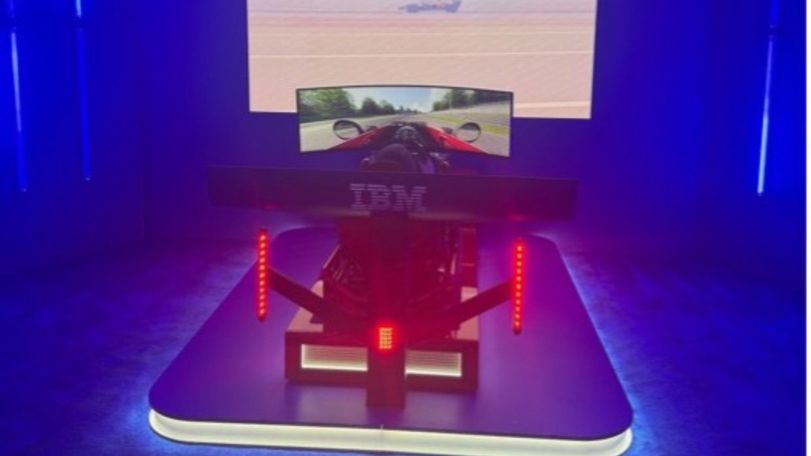
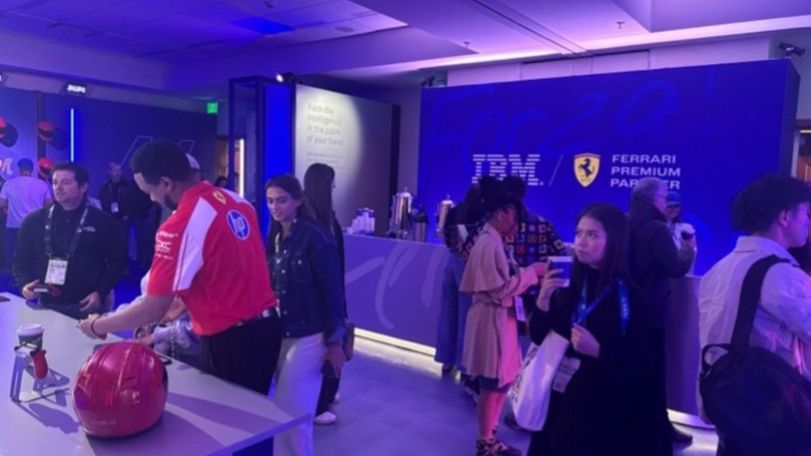
SXSW’s annual 'trade show’ exhibition side was full of the wonders of the latest tech for all to trial and enjoy again this year. Again, with AI writ large, IBM was also present with its AI Sports Club — a powerful interactive exhibition full of F1 simulators and driver Batak reaction walls showcasing the power of Ai in its Scuderia Ferrari HP partnership in Formula 1 (F1). This became one of the more popular activations of the week underlining that there is no doubt that F1, Ferrari and our very own Lewis Hamilton have now truly captivated the US audience across all ages — and it only seems to be getting more dominant.
1/2
2/2


One of the other great highlights for me of SXSW was hearing Niall Firth, executive editor Newsroom at MIT Technology Review, delivering his annual ‘10 Breakthrough Technologies'.
For this year’s list, AI dominated. He did reiterate some of Webb's predictions with the rise of Generative Coding such as Claude Code changing software development forever as well as AI companions such as Replika — he claimed that over 70 per cent of US teens now use these virtual friends, sometimes even for marriage guidance.
Niall also listed Personalised Gene Editing which can be life-saving for babies; 'Mechanistic Interpretability’[my new phrase of the week which I will be using liberally going forward], that is essentially neuroscience for LLMs to understand how they think and hopefully stop hallucinating. He also discussed hyperscale AI data centres such as Microsoft looking at nuclear to avoid the intensity of carbon production, pointing out that a five-second AI video creation may use as much energy as a microwave running for an hour.
Already AI is in all our lives whenever, wherever and forever — but humans still rule, for now.
2. AI Will Always Be Abused Wherever Possible
AI/generative AI is fuelling global stock market growth while also raising some uncomfortable questions. The session 'The Great Calibration; Centering Humanity in the Age of AI’ involving a panel with OpenAI's Tobias Peyerl tackled these head on.
Peyerl was refreshingly honest about how much control they have. While he said the goal of OpenAI continues to be ‘building Artificial General Intelligence to help the whole of humanity' and facilitating all the wondrous and creative opportunities that we now enjoy, he did say that they don't want to lead the debate as that is the role of a democracy.
He also admitted that they hadn’t expect ChatGPT to be used for medical purposes, and so are now working on its increasing value here, that they are hiring psychologists to understand ChatGPT's impact, and that they are not optimising the platform for engagement.
"Please hold us to account," Peyerl said. We should.
Meanwhile, the UN's head of data and AI, Lambert Hogenhout was less optimistic when he explained that governance is hard "because of the sheer speed of AI development." He reiterated how hard it is to trust what we see, what is real and what is fake online, and said it is naïve to believe that all AI corporates are only doing it for the good of humanity. More guardrails are needed, in his view.
Social health expert and author, Kasley Killam made it more personal: she claimed half of Gen Z have already had a relationship with AI as we see all-time highs for people seeking friendship in what is currently a loneliness epidemic. In her view, the red flag is when AI becomes the substitute for real human connections and so any tools we build should be in the service of ensuring we have more meaningful human connections.
As so often happens in the adoption curve of technological breakthroughs, what starts as eminently positive and harmless — such as gene editing to save lives — turns into less palatable phenomena such as designer humans or the societal inequalities that can bring.
As Kasley Killam neatly summarised “[With AI] we all need to be accountable — companies, governments, etc... We need to be proactive. We are the adults here."
3. Tech Is More Than Just Gen AI
One of the risks of Gen AI dominating so many conversations is that other genuinely transformational stories get crowded out.
Yes, AI tools may help fuel or are embedded in many of these innovations, but the broader technologies can often be even more life changing and are often as physically — or even biologically — advanced as they are digitally advanced.
The Waymo robotaxi fleet [see main image] cruising downtown Austin all week was its own daily reminder that autonomous transport is no longer theoretical. It was on the street outside the hotels, [as well as stopping at junctions I am glad to say].
Webb’s tech convergence predictions also included wearables such as human-enhancing exoskeleton trousers helping us walk and hike for even longer, as well as Genetic Rewinding to make cells biologically younger, and Japanese monk robots to meet a predicted job shortage, as well as fully automated dark factories running 24/7 with no humans on site.
As ever, SXSW's tech exhibition area was one of the most visited destinations all week, itself a signal that VR /AR /MR/XR are becoming more democratised and commercialised. The global debut of Fabula Rasa, a VR game driven entirely by AI-generated natural language conversations with every character (with no dialogue trees and no scripts) offered a glimpse of where storytelling in games is heading.

Snap debuted an augmented reality art exhibition with British painter Jonathan Yeo, powered by Snap Spectacles — fine art meeting spatial computing in a way that seems genuinely new rather than gimmicky. And the Agog Immersive Impact Award at the Film Festival went to A Long Goodbye, a VR piece about dementia which quietly said even more about the potential of immersive technology than some of the expo floor demos ever could.
ElevenLabs also pledged to restore one million voices for people with permanent voice loss — an example of technology deployed with genuine humanity at its core rather than just for efficiency or scale.
Niall Firth's top '10 Breakthrough Technologies’ also listed many hybrid physical /digital tech innovations to come:
Sodium Ion Batteries: Used by BYD in China to help with the scarcity and cost of lithium
Next Gen Nuclear: Such as SMR's and micro reactors with molten salt as coolants
Gene Resurrection: Bringing back extinct species, such as woolly mammoths, and even Game of Thrones’ dire wolves, or helping those animals or plants or vegetation in danger of extinction
Commercial Space Stations: Stations that NASA will one day rent
Embryo Scoring: Looking at characteristics, IQ, appearance, and all based around probability
So, the digital, the physical, the biological all converging in innovative tech often powered by — or embedded with — AI, but not exclusively AI/gen AI.
4. The Brits Over Here Still Love It Over There
The UK Creative Industries punched well above their weight at SXSW 2026. Brazil, Argentina, Australia, and many other countries had a strong presence this year also — there is no doubt that every year SXSW feels more global — albeit understandably still quite US-centric.
The merging of some of the UK's super soft powers of music, film, TV, and digital technology further helped fly the flag for our collective and mutually reinforcing creativity.
Aisling Conlon and her prolific UK AEG (Advertising Export Group) from the Advertising Association alongside SXSW loyalist and oracle Nigel Gwilliam with his IPA troupe were both visible and energetic, bringing the weight of the UK industry to panels, workshops, clubhouses, and BBQs throughout the week. The British (Music) Embassy at UK House in Austin was cited by many as one of the most happening places in Austin this year with its mind-blowing full music programme.
Among those was The Gate/MSQ's very own CSO Kit Altin with her session ‘Look What You Made Me Do: Revenge As Creative Catalyst’. She returned even sharper: a provocation about the creative power of the emotions we suppress — the grievance, the fury, the desire to prove someone spectacularly wrong. Revenge, she argued, properly redirected, is rocket fuel. Taylor Swift didn't just get even; she built an empire. In a week full of panels about Ai doing the creative heavy lifting, it was a necessary reminder of what is irreducibly human in the creative act. The room was packed.
UK House hosted over 60 emerging UK artists this year with Tom A Smith [a personal favourite of mine] as well as saw a Notting Hill Carnival-style music event in the street outside.
Collapsing buildings, collapsing festival strands, collapsing human and tech/AI. AI still serves us, but it helps make us more superhuman, it helps us use these superpowers even more every single day, and it helps us to build a more human-centric world.
So, I look forward to SXSW 2027 to learn and discover and open-up my mind even more… that is assuming my agent does not decide to go on my behalf.
Stephen Maher is the chair of The Gate (part of MSQ)
Share


