/f/102932/595x669/77cc3c6f17/vic-robertson-starbucks.jpg)
CMO Spotlight
Starbucks UK Is Championing Creativity... and Coffee
CMO Vic Robertson discusses its new campaign, the importance of in-person creativity, and igniting Gen Z
14 September 2026
For Vic Robertson, the priority at Starbucks UK is clear: build the brand for the long-term.
Since joining as its marketing director a year ago from SSP UK Ltd, she is leading the charge for its first UK-based campaign in a number of years, Made in Starbucks. The change, she says, is something she wanted to implement as soon as she could.
Moving away from the short-term product drops and limited-time offers that dominate coffee marketing, Robertson has a keen eye to invest in the brand’s bigger story — what Starbucks means to its audience, to celebrate its role in the push for creativity to flourish, and keep coffee cups in hands.
“I spent an awful lot of time when I joined the business working with agencies and really understanding the necessity for long-term investment in brand,” she begins. “If you're not careful, you can get hooked on these short-term LTO-driven product drops. But actually, you need to do that, plus you need to be investing in brand long-term.”
It’s a strategy that marks a full-circle moment for Robertson; she first worked with the brand as a client in 2013, offering her a rare position over the years to understand its roots.
“I might have manifested moving to Starbucks at some point because I worked with them for such a long time and just fell in love with the brand and what they stood for,” she explains. “The nice vantage point that I had in my last job, I was a director of franchise and I looked after 12 different brands, but Starbucks has always been quite special. It just felt quite personal. It's always just been close to my heart.”
Igniting the UK market
Despite having not rolled out a UK based campaign in recent years, Robertson believed the timing off the back of campaign successes in the US was perfect.
“I just knew that this was the right thing for us,” she says. “It made sense from a timing perspective because we’d woken the world up with Hello Again and the Back to Starbucks campaign. It make sense to continue that and to enrich it in the UK culture.”
Off the back of these campaigns, she adds, Starbucks UK wanted to make the most of the momentum it had gained.
“We saw there was a real uptick in brand health metrics in the UK as a result of that work — an increase in consideration, an increase in trust scores. What that told us was the UK public are actually willing, ready and able to take in some insight into what Starbucks in the UK means to them.”
And the campaign brief aimed to achieve exactly that: tackle what Starbucks means in the UK; “What is our heritage? What does it stand for? What does it represents? What does it mean to people?”
Insight driven work
The work is deeply rooted in insight, based off Starbucks’ own data, which found that 73 per cent of Millennials and 65 per cent of Gen Z say face-to-face interaction is essential for generating creative ideas, 58 per cent worry that the spaces where people can connect, collaborate and create are disappearing, and 36 per cent believe it will negatively impact their creativity.
“I was surprised but also not surprised by the findings,” Robertson outlines. “I think technology has really helped people to be creative, but it's not a replacement. Even if you just look at local knitting groups — we featured one in the ads that actually regularly come into our Starbucks stores — that's not something that you can do online.
“If you pay attention to what's happening in social media; people are crying out for these kind of in-real-life experiences — online dating being replaced with actually just getting together in venues and meeting people the old-school way, you can kind of see that momentum starting.”
Starbucks as a brand has always stood for connection, she adds; when the brand first landed in the UK in the 1990s its purpose was to be a place to connect and come together without being rushed to leave your seat.
“The biggest thing I learnt from the insights given by our strategy partners, Anomaly, was that coffee in the UK has always been an energiser of creative ambition,” Robertson explains. “They went back to penny universities in the 1700s and how that's where, over a cup of coffee, people got together and collaborated. So this isn’t just about Starbucks. This is about coffee fuelling ambition.”
The shared insights also spoke about how the UK “really punches above its weight” when it comes to creativity.
“They talked about the Bs — There's Bond, Bowie, Blue Planet, The Beatles, and even Mr Bean. I love that truth: that creativity is the currency of cool in the UK. We really wanted to tap into that and bring it all together when you think about our coffee houses.”
Championing creativity
The heart and centre of the campaign is the in-person experience Starbucks provides — especially when it comes to championing creativity. And this channels to its partners - the name Starbucks gives to its employees, from barista to support centre.
1/2
2/2


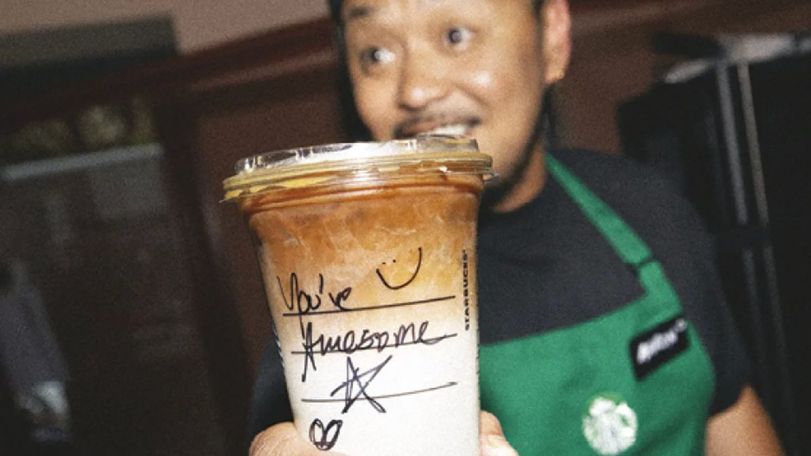
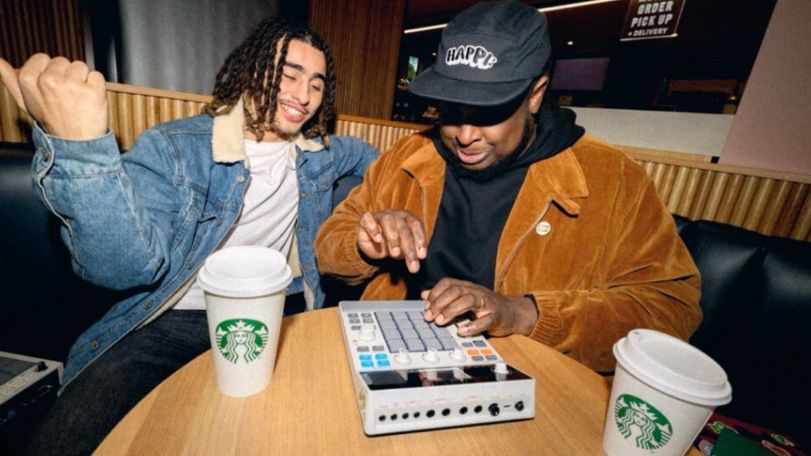
“The campaign features people who are actually creating already in our spaces and celebrates them and brings them to the fore,” Robertson adds. “I saw something on LinkedIn actually — somebody who's completely unrelated to us wrote a little write-up on the ad, and one of the things they called out was they just loved the fact it featured nothing AI. It was all about people. And then when you get into the detail of it, they understood that we were using actual Green Apron partners. There's no substitutions here. It's all authentic.”
For decades, Starbucks has opened the doors to its coffeehouses, whether that’s for organised clubs, the beginning of side hustles, or a place to brainstorm. And that’s something that needed to be translated through the work.
“Our director was incredibly patient with us because little things like they were filming a shot where it was over the shoulder of one of out Green Apron partners, and you could see customers coming up at the handoff section. And we just said, ‘That's too fast. There's no engagement. We engage with our customers at handoff of every cup.’ Being able to influence that from a Starbucks perspective was really invaluable.”
The work doesn’t stop there. Robertson notes that activations will be coming up across the summer into 2027 to “further establish” the position that Starbucks is the place to come together.
“There'll be things like the Illustration Club, which is about encouraging artists to create, celebrating them with an exhibition. It's all going to be anchored around celebrating creative communities and also linking them into our coffee houses.”
The world of marketing according to Vic Robertson
What do you enjoy most about the industry and being a marketer?
I think the obvious one is just being able to be creative. Being able to have that connection with people as well, and invoke emotions and experiences. All over our comments on Instagram — I've been obsessed with even the drop of the summer Barista Cup this morning. I've been in all of the comments just seeing what people have to say.
So I love that kind of direct connection with what you do and how it makes people feel.
And on the flip side of that, what do you find to be the most frustrating thing about the industry?
Convincing people how important it is to invest in brands over time. I think there are a lot of people that want instant impact. You do one thing and you see the impact the next day, and it's not about that. So I think it just takes a long time to educate people who aren't close to it about how important it is to do the long-term brand investment. So it can be frustrating for people who don't understand.
Across your career, what would you say is your proudest moment?
It's going to have to be filming the ad. I was lucky enough to go to Seattle earlier on this year, and I heard Brian Niccol [Starbucks' CEO] speak. It was just before they launched the Coffee Run ad.
Brian said Tressie Lieberman [Starbucks' global chief brand] was in every still, every scene. She was feeding back, and I really took that to heart. I probably was the producer's worst nightmare, but I absolutely loved touring around the UK, just being completely immersed and wrapped up in that creative process, hanging out with the Green Apron partners, hanging out with all of the creatives, and just seeing it all come to life.
The hours of conversations on what was the right track to select, and just really being in the detail, were a massive highlight. I get goosebumps every time I hear it.
And what would you say is a campaign that you personally didn't work on, but really wish you did?
I'd say anything that McDonald's UK are coming out with. I particularly like how they're heroing their core menu; I think it's clever.

These out-of-home billboards with the milkshake and the dipping of the fries in it are so smart because this isn't just about the new shiny next thing. This is about, ‘We're here for your craveable everyday products that you just absolutely love, and whatever bonkers twist you wish to put on them, we're here for you.’ So I always find inspiration with anything that McDonald's do.
If marketing didn't exist, what do you think you would find yourself doing?
Well, my retirement plan is I'd love to buy a boutique hotel. It just goes back to this people and hospitality and service thing. I don't think that's ever left me. So I imagine myself being one of those irritating owners that kind of drafts in all of the fun moments. But a pub with rooms, with event space, where you can be part of people's experiences. I think I'd love to do that.
Share


